
Chapter 5 of the unpublished 1980s blockbuster Scythe Hockey and Other New Age Sports, by F.R. Duplantier, Alan Huard, and Sid Berger:
DISCLAIMER: This excerpt is not meant to be taken seriously. The sport described here is dangerous, and only an idiot would attempt to play it. Don’t be an idiot.
Arnold Beekler was his neighborhood’s answer to Tom Sawyer, Clarence Darrow, and Ernie Bilko all rolled into one. Adults dismissed him for what they took as laziness, but his peers knew that his talent for avoiding work while capitalizing on the situation was sheer genius. His specialty was eliminating the monotony from tedious household chores. Skateboarding the garbage cans to the curb, hosing the dishes clean, and splash-painting the outdoor furniture not only exhibited his ingenuity, but demonstrated his ability to talk his parents, or anyone else, into just about anything he wanted.
Scythe Hockey was such a creation. By the time Arnold was ready to sell the idea to his friends, he had already worked out the rule modifications, as well as secured 12 scythes from his uncle’s hardware store. They knew immediately that he was trying to hustle them into cutting the grass on his father’s vacant lot. But when he described the thrill of flying across the field and slamming that puck into the net — well, the rest is sports history.
Field and Equipment
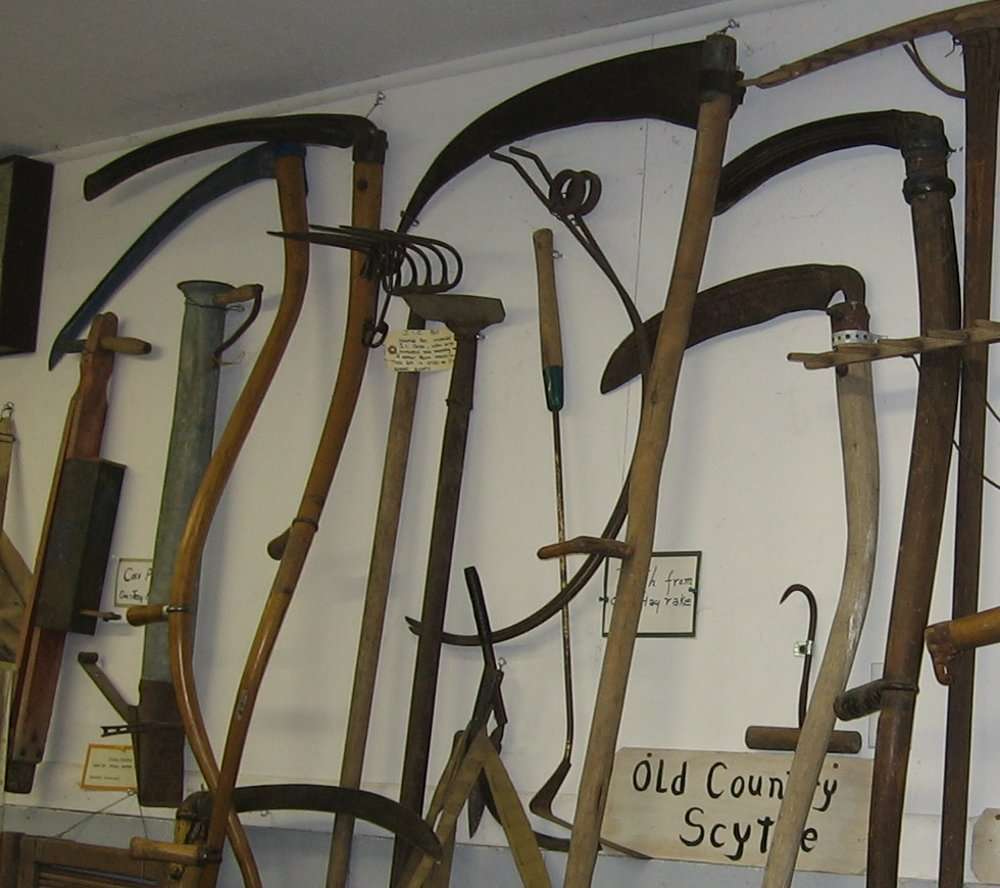
Though almost any size field will do, the official Arnold Beekler Scythe Hockey field measures 120 x 180 x 110 x 200 — the dimensions of Mr. and Mrs. Dexter Beekler’s original lot — and purists still take pains to mark off this exact area. The game, needless to say, is played with scythes rather than sticks. A basic two-handle cradle scythe provides excellent control and balance. Even seasoned ice hockey players have commented on the advantages of the dual-handle concept for quicker response and greater accuracy. Scythe Hockey players kept hardware-store-availability in mind when adapting other playing equipment, settling on hollow metal toilet tank floats as the ideal pucks. Their spherical shape facilitates travel across the grass field, while their corrugated, center-seam construction resists damage from a sweeping scythe’s blade. A regulation framework goal with netting can also be built from items found in any hardware store. Sturdy metal pipe is preferred to PVC, however, since it better withstands accidental slices from the scythes. For the same reason, chicken wire is recommended over common fishnetting for caging in the back and sides.
Mown Grass
One question all players ask after a few minutes into a game is what to do with the mown grass. This is an expecially important consideration on heavily overgrown fields. Most players choose one of two general strategies and have come to be known as either “grassers” or “rakers.”
Grassers use the mown grass as a strategic tool. Carefully positioned piles of grass create defensive barriers for opponents and form offensive channels for passing among teammates. Goalies often create mulch fortifications around the perimeter of their goals. And, when the grass is high and thick enough, players may totally conceal themselves behind a stack. This adds an exciting dimension to the game, for the advancing puck carrier never knows where the next defensive player may pop up.
Rakers prefer long unobstructed shots across a clear field, instead of the strategic maneuverings of the grassers. Rakers clear the field of grass as soon as it’s cut. In addition to frequent “rake breaks,” players out of range of the puck will keep their scythes swinging to work any cut grass beyond the sidelines. Some rakers even allow their goalies to play the entire game with rakes instead of scythes. In the rare cases when rakers play against grassers, it is invariably the rakers who win, since they constantly remove the grassers’ piles as fast as they can make them. Then the rakers have the advantage of playing their style of hockey on a clear field.
Scythe Hockey can be a very demanding sport. Many a game, and many a player, is cut short for lack of stamina. It’s advisable, therefore, to have several substitutes standing close by — but not too close.
Glossary
Face-Off. Opening position taken by two opposing players to begin play. In extremely high grass, it may be necessary for the referee to announce quite loudly that the puck is in play. (Also refers to the injury sustained from a scythe swung too close to a player’s head.)
Hand-Off. Close-quarter pass between teammates, or the injury sustained during such a maneuver.
Slice. Swinging motion of scythe — downward, upward, or crosswise — or the injury therefrom.
Harem Slice. Also known as Soprano Slice, being a cross slice at groin level.
Partial Transfusion. Replacement of more than half of a team’s players within any one quarter.
Total Transfusion. Replacement of all of a team’s players within one quarter.